← journalThu Aug 06festival · hoian · danang · route7 min
Mid-Autumn Festival Hoi An 2026: The Thiên Cẩu Nights of 22–25 September
Tết Trung thu in Hội An is national intangible heritage, not a children's party — four nights on the eighth lunar moon, a four-person celestial-dog dance found nowhere else in Vietnam, and one lantern night when the Old Town cuts its electric light. In 2026 the window is 22–25 September.
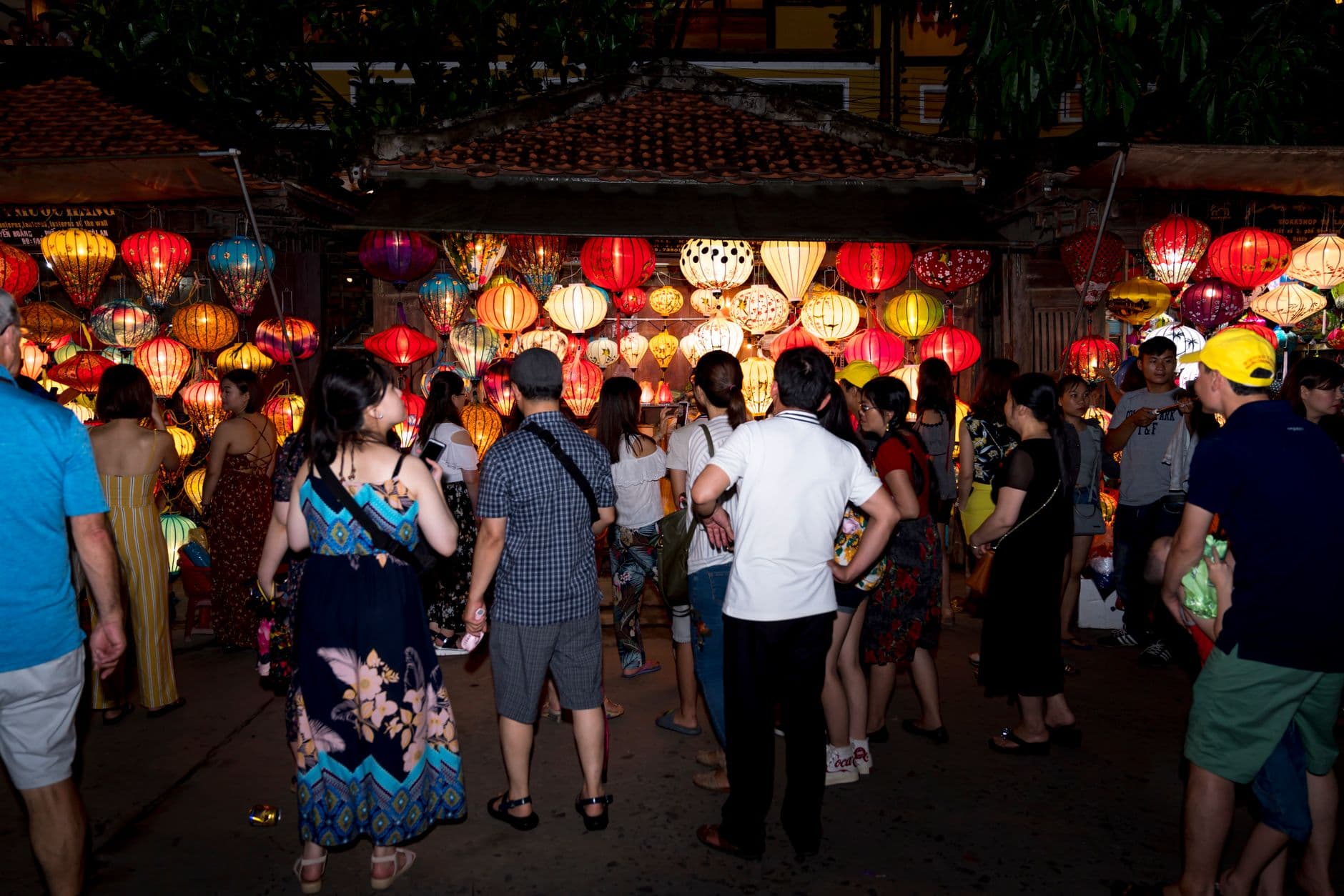
Most visitors meet Tết Trung thu somewhere else first — a mooncake box in a hotel lobby, a paper star lantern in a shop window — and arrive in Hội An expecting a children's evening. Then a drum starts two streets away, something with a five-coloured head the size of a washing machine comes round the corner carried by four people moving in martial-arts footwork, and it is clearly a different thing entirely. Hội An's Mid-Autumn is on Vietnam's national heritage list, and the reason is that beast.
For drivers it is also the most demanding four nights of the autumn: the biggest monthly lantern night lands on the eve, the parade closes the heritage grid at exactly the hour everyone wants dropping off, and it all falls on a working weekday.
When is Tết Trung thu in Hội An in 2026?
Trung thu proper falls on Friday 25 September 2026 — the 15th day of the eighth lunar month, the full moon the festival is named for. But Hội An does not run a one-night festival. In 2025 the programme opened on the 12th lunar day and ran four nights, 3–6 October. The same shape mapped onto 2026:
| Lunar date | 2026 date | What it has been |
|---|---|---|
| 12/8 âm | Tue 22 Sep | Opening — displays, craft spaces, offering trays |
| 13/8 âm | Wed 23 Sep | Music and folk-song sessions on the riverfront |
| 14/8 âm | Thu 24 Sep | Đêm Rằm Phố Cổ, the lantern night, plus the main stage programme |
| 15/8 âm | Fri 25 Sep | Trung thu: lantern procession and thiên cẩu through the Old Town |
Treat the lunar anchors as fixed and the programme as a pattern rather than a promise — the city publishes the confirmed schedule a few weeks out. And Trung thu is not a public holiday: nobody gets the day off, which is why the festival compresses into the hours after work.
The collision on Thursday 24 September is the part worth planning around. The 14th night of every lunar month is Hội An's Đêm Rằm Phố Cổ, when the heritage streets cut their electric light and run on silk lanterns and candle boats. Once a year that night is also the eve of Trung thu — the most crowded evening of the Hội An autumn, and the most beautiful.
Why is Hội An's Mid-Autumn national heritage?
Because the Ministry of Culture, Sports and Tourism said so, in writing: Decision 228/QĐ-BVHTTDL of 14 February 2023 inscribed the traditional festival, social practices and beliefs of Tết Trung thu ở Hội An on the national list of intangible cultural heritage, and the town received the designation at a ceremony in Hội An Park on 28 September 2023. What the citation singles out: a festival shaped by the port's own habits crossed with centuries of Japanese and Chinese exchange, kept up by the community rather than staged for anyone, and carrying one folk form — the thiên cẩu dance — that survives here and essentially nowhere else in the country.
What is múa thiên cẩu, and how is it not a lion dance?
Thiên cẩu means celestial dog: a mythological guardian, not the lion (lân) you see everywhere else in Vietnam at Trung thu and Tết. The differences are physical and immediate. A lion dance takes two performers. A thiên cẩu takes four — one under the head, the others carrying body and tail so the creature ripples and twists as one animal. The steps are stricter, drawn from martial-arts footwork rather than acrobatics. The head is built by hand on a bamboo frame, layered with cloth and paper, then painted in the five elemental colours of ngũ hành, which is why it reads as gaudy and slightly frightening at close range under lantern light.
What it does matters more than how it looks. The thiên cẩu enters a house, bows to the family altar, prowls the rooms hunting its food, drives off what should not be there, eats what is offered and thanks the household. Around that sit older beliefs — opening the creature's mouth over a child to draw off wind and illness, licking a doorway clean of bad luck — and set pieces like chưng cộ vờn mây (playing with the clouds) and thiên cẩu thổ địa, the beast and the earth god, asking for good weather and a quiet year. The dance appeared at scale around 1940, an adaptation by settlers from the north-central provinces of the lion and dragon dances they brought with them, and it never left.
Where do the heads and lanterns come from?
Closer than you would guess. The Bảo tàng Văn hóa Dân gian (Museum of Folk Culture) at 33 Nguyễn Thái Học, a timber house 57 metres deep at the Bạch Đằng corner, displays thiên cẩu through the festival and runs painting and mask-decorating sessions children can join.
The heads themselves come from one family workshop at Cẩm Hà, on the market-garden edge of town ten minutes north — reported by the national press as the last place in Hội An still building thiên cẩu and lion heads by hand, more than three decades in. Four stages: frame, skin in cloth and paper, paint, fur. Around it runs the season's other craft — silk-and-bamboo lanterns, the old ông sao star lanterns children carry, and the mâm cỗ Trung thu, trays of pomelo, custard apple, cakes and tea set out in heritage houses and shopfronts for anyone walking past.
How do these nights actually drive?
The Old Town is never driven. Cars do not enter the heritage grid at any hour, and the pedestrian regime closes it entirely for roughly 9–11:30 am and again from mid-afternoon until about 9 pm. Trần Phú, Nguyễn Huệ, Công Nữ Ngọc Hoa and the Bạch Đằng river road go car- and motorbike-free through the evening block. Parking sits outside, at the night-market lot and the town square; everything else is a perimeter drop-and-go.
On 25 September the procession owns the streets. The lantern parade — schools, thiên cẩu troupes, lion and dragon teams, children's music groups — has recently run 5:30 to 7:30 pm. Be inside the quarter before it starts, not arriving into it.
Timings from the road:
- From a Hội An hotel (An Bàng, Cẩm Thanh, the beach road): 10–15 minutes to the perimeter normally; allow 25 on the 24th and 25th, when the approach roads and bridges load up from mid-afternoon.
- From Đà Nẵng: about 45 minutes down the coastal road. For a 5:30 pm parade, leave by 4:15–4:30 pm. Later than 5 and you spend the difference crawling the last two kilometres.
- From Huế: roughly three hours by the tunnel, nearer four over the Hải Vân Pass — a transfer with an overnight at the end of it, not an evening out.
The return is the part people forget. Around 9 pm several thousand people leave at once and the perimeter roads clog in every direction. The fix is unglamorous and it works: agree a specific corner and time before you walk in, then either go at 8:30 pm ahead of the wave or sit down for another hour and leave at 10. Drivers wait; junctions do not clear.
What is the weather doing in late September?
Late September is the hinge into the wet half of the central-Vietnam year — warm, humid, rain probability climbing, but not yet the sustained October–November pattern. Mornings hold up, evening rain arrives hard and passes, and the programme carries on under awnings.
One footnote, because it changes what you will read in official notices: since 1 July 2025 Quảng Nam and Đà Nẵng have been a single city, and Hội An is now a ward of Đà Nẵng. The festival is unchanged; the letterhead is not.
The short version
Be in Hội An on Thursday 24 and Friday 25 September 2026 — the 24th for the lantern night, the 25th for the procession. Walk in before half past five and let the thiên cẩu find you rather than chasing the drums.
If those evenings need a car at either end — an airport run landing you before the streets close, or a driver holding a corner at 10 pm while you finish dinner — describe the trip at hoiandriver.com/quote. A real driver prices it, one click books it with nothing to pay now, and the whole total is settled at trip end in the US dollars quoted.
good questions
- When is the Mid-Autumn Festival in Hoi An in 2026?
- Tết Trung thu itself falls on Friday 25 September 2026, the 15th day of the eighth lunar month. Hội An's festival runs wider than the one night — recent years have opened on the 12th lunar day, which puts the 2026 window at roughly Tuesday 22 to Friday 25 September.
- Is the Mid-Autumn Festival a public holiday in Vietnam?
- No. Offices, shops and museums work a normal day; the festival lives in the evening, which is why the streets fill so hard between about 5 pm and 9 pm.
- What is the thien cau dance in Hoi An?
- Múa thiên cẩu is the celestial-dog dance, a Hội An-specific folk form. Where a lion dance takes two performers, the thiên cẩu takes four — one under the head, the rest carrying body and tail — and its steps follow martial-arts footwork. The head is built on bamboo, cloth and paper and painted in the five elemental colours.
- Why is Hoi An's Mid-Autumn Festival special?
- It was inscribed on Vietnam's national list of intangible cultural heritage in February 2023 — the traditional festival, social practices and beliefs together. Its form grew out of local custom crossed with centuries of Japanese and Chinese exchange in the port, and the thiên cẩu dance survives here and effectively nowhere else.
- Is there a lantern night during Mid-Autumn in Hoi An?
- Yes, and they collide. The Old Town's monthly Đêm Rằm Phố Cổ falls on the 14th lunar night, which in 2026 is Thursday 24 September — the eve of Trung thu. That is the night the heritage streets switch off electric light in favour of silk lanterns.
- Can you drive into the Old Town during the festival?
- No. The heritage grid is pedestrian-only for long stretches of the day — roughly 9–11:30 am and from mid-afternoon to about 9 pm — and no car enters those streets at any hour. Drivers drop at the perimeter and you walk in; on parade evenings the drop-off sits further out than usual.
- How long does it take to get to Hoi An from Da Nang for the festival?
- About 45 minutes down the coastal road on an ordinary evening. For a 5:30 pm start, leaving Đà Nẵng around 4:15–4:30 pm gives you margin for the approach roads, which thicken from mid-afternoon on the big nights.
- What is the weather like in Hoi An in late September?
- Warm and humid with rain probability climbing toward the wet season. Mornings are usually the reliable half of the day; evening showers are short and heavy rather than all-night, and the festival programme carries on around them.
sources
- Cổng Thông tin điện tử thành phố Đà Nẵng — Lễ hội Tết Trung thu Hội An
- Phố cổ Hội An – Di sản văn hóa thế giới (Thông tin Hội Tết Trung thu Ất Tỵ 2025 ở Hội An)
- Báo Nhân Dân — Đón nhận danh hiệu di sản văn hóa phi vật thể quốc gia Tết Trung thu ở Hội An
- Báo Điện tử Chính phủ — Hội An đón nhận danh hiệu Di sản văn hóa phi vật thể quốc gia Tết Trung thu
- Báo Đại biểu Nhân dân — Hội Tết Trung thu Ất Tỵ 2025 tại Phố cổ Hội An
- Báo Thanh Niên — Những nghệ nhân cuối cùng: người duy nhất làm đầu thiên cẩu ở phố Hội
- Trung tâm Quản lý Bảo tồn Di sản Văn hóa Hội An