← journalThu Aug 06airport · route · danang · hoian5 min
Da Nang Airport to Hoi An 2026: The Arrival Walkthrough From the Driver's Seat
What actually happens between the jet bridge at Da Nang Airport (DAD) and your hotel in Hội An — immigration, SIM, ATM, pickup options compared, and the 30 km coastal road, written by the people who drive it daily.
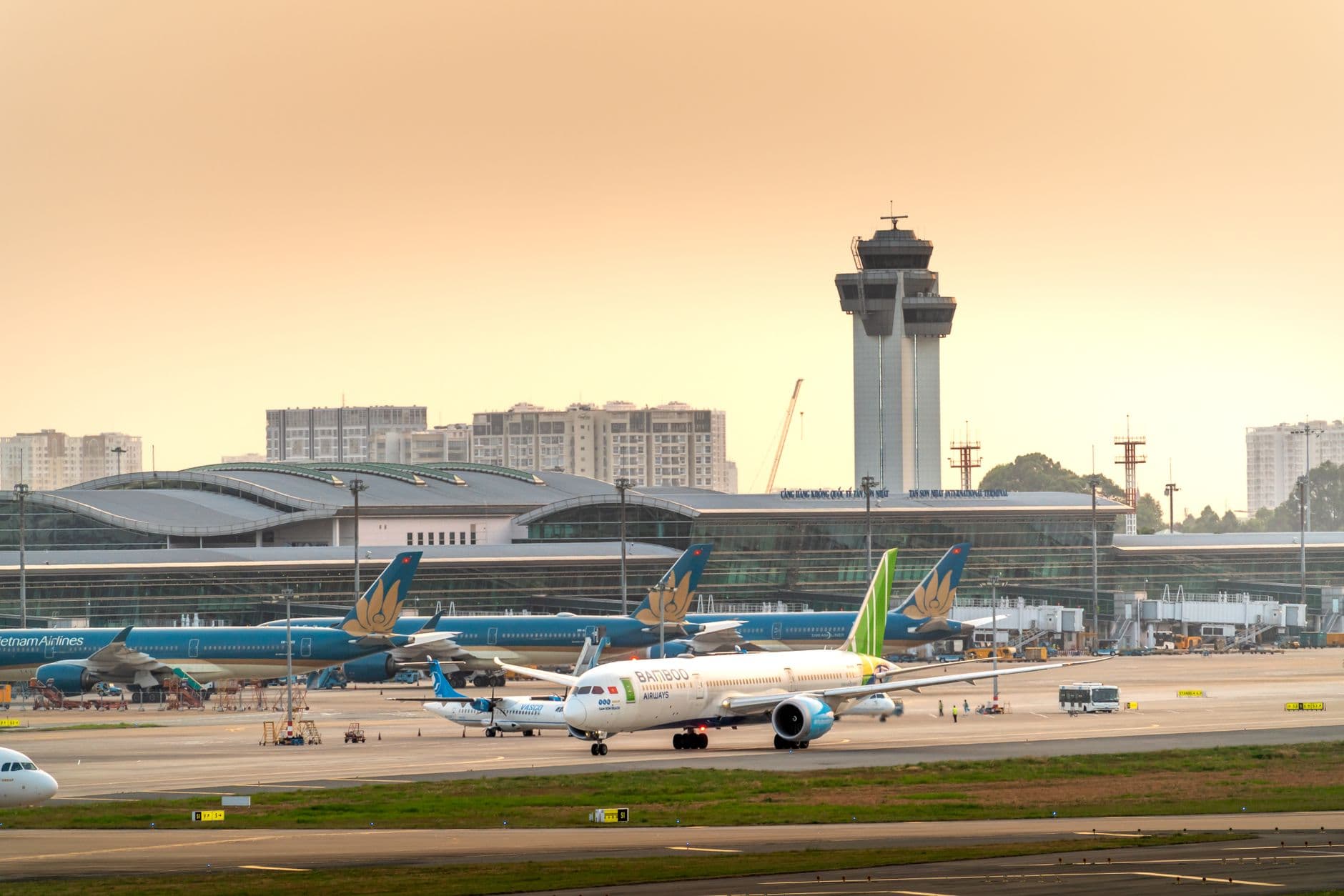
Our drivers begin more mornings at Da Nang International Airport (DAD) than anywhere else in central Vietnam. It is where almost every Hội An trip starts: the closest international gateway to the Old Town, roughly 30 km to the north, with a coastal road between the two that takes about 45 minutes when traffic behaves. Here is the arrival in the order it actually unfolds — and what the pickup looks like from our side of the sliding doors.
Which terminal will you land at?
DAD has two terminals connected by a short covered walkway. International flights — Singapore, Seoul, Bangkok, Kuala Lumpur, Taipei, Doha — come into Terminal 2, the newer four-floor building of about 48,000 m². Terminal 1 handles domestic traffic, so if you connect through Hà Nội or Hồ Chí Minh City you will walk out of T1 instead. Whoever is collecting you only needs the flight number; the terminal follows from it.
The ground floor of T2 is laid out in one straight line: immigration, baggage belts, customs, then the public hall with SIM counters, ATMs and exchange desks. You walk it once, in a single direction.
How long does immigration take with an e-visa?
Vietnam now runs on e-visas for most nationalities. The 2026 rules: 90 days of validity, single or multiple entry, open to citizens of every country, at US$25 single entry or US$50 multiple — paid only on the official portal, evisa.gov.vn. Processing takes 3–5 working days, so apply at least a week before flying. DAD is among the 83 border gates that accept it.
Inside the hall there are three streams. E-visa holders queue for the staffed counters — the automated gates are reserved for Vietnamese passports and a few bilateral schemes. Visa-on-arrival travellers, a shrinking group, collect their stamp at a separate desk on the right before joining the same staffed lane. Visa-exempt passports (UK, Germany, France, Italy, Spain, Japan, Korea and several others) go straight to the counters. Keep your passport and a printed e-visa in hand; the officer asks a question or two and stamps you through. Budget 10 minutes if your flight landed alone, up to 30 if several wide-bodies arrived in the same wave.
One thing worth knowing from our side: a booked pickup is priced to the flight, not to the clock. If the queue swallows half an hour, no meter is running outside.
Should you sort your SIM and cash before walking out?
Yes — these are the two airport errands genuinely worth doing. The SIM kiosks are immediately to your right after customs. All three major carriers sell tourist packages with English-speaking staff: Viettel has the widest network, the safe pick if your plans include Mỹ Sơn or Cù Lao Chàm; Vinaphone is strong in the cities and slightly cheaper; Mobifone has long been the foreigner-friendly option. A 30-day unlimited-data SIM costs about 200,000–300,000 VND (US$8–12). Registration against your passport is required by law, and staff activate the card in front of you. Buying it later in Hội An saves nothing and adds queueing.
At the ATMs, fees for foreign cards swing widely between banks. VPBank has historically charged nothing (confirm on the screen that day). Vietcombank takes about 55,000 VND per withdrawal with a 3,000,000 VND ceiling; Sacombank sits around 30,000–40,000 VND; BIDV charges roughly 3% of the amount, the expensive choice for a big pull; TPBank added a foreign-card fee in 2025. The arithmetic favours one large withdrawal over several small ones — and always decline the machine's offer to convert to your home currency, because your card network's rate beats it. The exchange desks in the hall run about 1–2% below what Hội An's gold shops pay, so change only US$100–200 for the first day.
Cash covers street food, market stalls, beach loungers, motorbike rentals and tips. Cards and QR codes handle most sit-down restaurants, museums and hotels. Carry both.
If a driver is waiting for you, these ten minutes are already part of the job — the name board does not expire.
Grab, taxi, or a booked driver — what does the 30 km really cost?
Three realistic options stand between the terminal and the Old Town:
- Pre-booked private driver — roughly 450,000–700,000 VND. The driver stands inside arrivals with your name on a board, takes the bags, and the car is at the curb rather than down a lane. This is the option that earns its premium late at night, with small children, or with a trolley-load of luggage.
- GrabCar — usually 320,000–420,000 VND, fixed in the app before you commit, so nothing can be added en route. The pickup is not at the door: turn left out of arrivals and walk about 3 minutes past the official taxi rank to the signed zone at Lane 1.
- Metered taxi (Mai Linh, Vinasun) — about 380,000–500,000 VND on the meter. Reliable companies, but make sure the meter starts before the wheels do.
Grab is honestly the cheapest way down. What a booked driver sells is the absence of friction at the exact moment you have the least patience for it.
What does the road to Hội An actually look like?
The route swings east from the airport and then runs south down the coast: the long stretch of Mỹ Khê beach on your left, the five limestone outcrops of the Marble Mountains at roughly the halfway mark, the stone-carving workshops of Non Nước, and then the rice-field approach into Hội An from the north. Traffic is usually light. Door to door, count on about 45 minutes; the evening rush around Đà Nẵng (roughly 4:30–6:30 pm) can stretch it, and a midnight run often comes in nearer 35. The Marble Mountains sit so conveniently on this road that many travellers save them for a first morning back up the same coast rather than squeezing them into arrival day.
What if you land at 11 pm — or your flight runs late?
Late arrivals are routine at DAD; the airport receives flights deep into the night and the coastal road is at its emptiest then. A pre-arranged pickup is tied to your flight number, so a delay moves the pickup with it rather than cancelling anything. Grab works at midnight too — the part people regret is the Lane 1 walk with a week's luggage after a long-haul.
Whatever you ride, resist making decisions in your first three hours on the ground. Check in, drink water, walk to the nearest bowl of noodles. Nothing about Hội An rewards being rushed at; the lanterns will still be lit tomorrow.
Practical reference
- Airport code: DAD (Da Nang International Airport)
- Distance to Hội An: about 30 km — around 45 minutes by car
- E-visa: evisa.gov.vn — US$25 single / US$50 multiple, 90 days
- Currency: Vietnamese đồng; roughly 25,000 VND ≈ US$1
- Plugs: types A, C and F — flat US and round EU pins both fit
- Time zone: UTC+7, no daylight saving
If you would rather land with the pickup already solved: tell us your flight at hoiandriver.com/quote — a real driver prices the trip, and one click books it, with nothing to pay now.
good questions
- How far is Da Nang Airport from Hoi An?
- About 30 km. The drive along the coastal road takes around 45 minutes door to door — closer to 35 late at night, longer in the evening rush.
- How much is a Grab or taxi from Da Nang Airport to Hoi An?
- GrabCar usually shows 320,000–420,000 VND fixed in the app. Metered taxis (Mai Linh, Vinasun) run about 380,000–500,000 VND. A pre-booked private driver is roughly 450,000–700,000 VND and meets you inside arrivals.
- Do I need a visa before landing at Da Nang?
- Most travellers use Vietnam's e-visa: 90 days, single or multiple entry, US$25 or US$50, applied for at evisa.gov.vn. Allow 3–5 working days. Some passports (UK, Germany, France, Japan, Korea and others) enter visa-exempt.
- Which terminal do international flights use at DAD?
- Terminal 2. Terminal 1 is domestic, so connections through Hà Nội or Hồ Chí Minh City exit there — a short covered walkway links the two.
- Where is the Grab pickup point at Da Nang Airport?
- Not at the curb. Turn left out of arrivals and walk about 3 minutes past the official taxi rank to the signed Grab zone at Lane 1.
- Should I buy a SIM card at the airport or in Hoi An?
- At the airport. The kiosks sit just past customs, a 30-day unlimited-data tourist SIM costs about 200,000–300,000 VND (US$8–12), and staff register it to your passport and activate it on the spot.
- Which ATM at Da Nang Airport is cheapest for foreign cards?
- VPBank has historically waived foreign-card fees; Vietcombank charges about 55,000 VND per withdrawal with a 3,000,000 VND cap; BIDV takes roughly 3%, the worst for large pulls. Always decline the machine's currency conversion.